
Please see below news items about Oliver Pain, the Wohl Cellular Imaging Centre, King’s Organoid Research Interest Group, and the Ahmad Al Khleifat, Ammar Al-Chalabi, Emma Clayton, Caroline Vance and Sarah Marzi lab groups.
Oliver Pain, a BCN Research Fellow, has been nominated a a rising star by the journal Genomic Psychiatry.
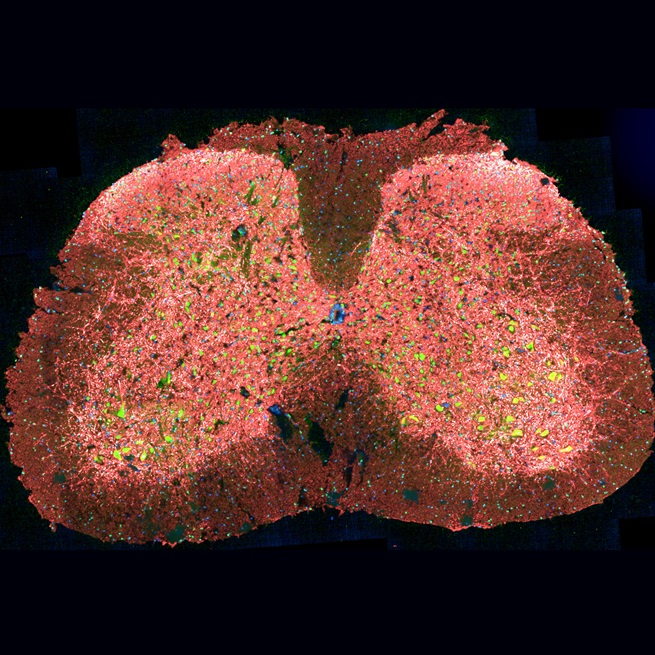
News from the WCIC
Dr Laura Odemwingie won the WCIC Image Competition this Summer with “TAF15 in Lumbar Spinal Cord”.
Entries are open for the Autumn round. Anyone can enter.
Please see link below:-https://bsky.app/profile/wohlmicroscopy.bsky.social
Invitation to the Organoid Research Interest Group
The King’s Organoid Research Interest Group (ORIG) is for all researchers at King’s in the field of organoid research. They hold a free monthly ORIG Lunch and Journal Club for ECRs on Fridays in Guys Hospital Tower, 28th floor Seminar Room 2. If you would like to join the mailing list or volunteer to present in the Journal Club session, please contact Bowen Gao (bowen.3.gao@kcl.ac.uk).
News from Ahmed Al-Khleifat

Dr Ahmad Al Khleifat featured on a BBC Arabic podcast discussing the recent approval of Lecanemab in Saudi Arabia. He addressed challenges such as treatment cost, the need for specialist follow-up and infrastructure support, and highlighted the lack of efficacy data in Middle Eastern and other non-European populations. https://podcasts.apple.com/gb/podcast/%D9%8A%D8%B3%D8%AA%D8%AD%D9%82-%D8%A7%D9%84%D8%A7%D9%86%D8%AA%D8%A8%D8%A7%D9%87/id1726949222?i=1000721084398
Also, Ahmad would like to highlight that the Culture, Equality, Diversity and Inclusion (CEDI) Impact Award is now open. https://www.maudsleybrc.nihr.ac.uk/about-us/equality-diversity/culture-equality-diversity-and-inclusion-cedi-impact-award/
News from Ammar Al-Chalabi
The Annual Stephen Hawking MND Lecture is now open for registration. This year’s lecture will be delivered by Professor Ammar Al-Chalabi and will explore the role of genes in MND. https://www.mndassociation.org/professionals/professional-education-and-development/shfl
Emma Clayton has been awarded an 18-month pilot grant from Parkinson’s UK to investigate Synaptopathy in Parkinson’s (in collaboration with Dr Sarah Marzi and Prof Deepak Srivastava).
Laura Odemwingie passed her viva with minor corrections (supervisors Marc-David Ruepp and Caroline Vance)
News from the Marzi Lab
Congratulations to Dr Kitty Murphy for leading two new papers in the Marzi lab:
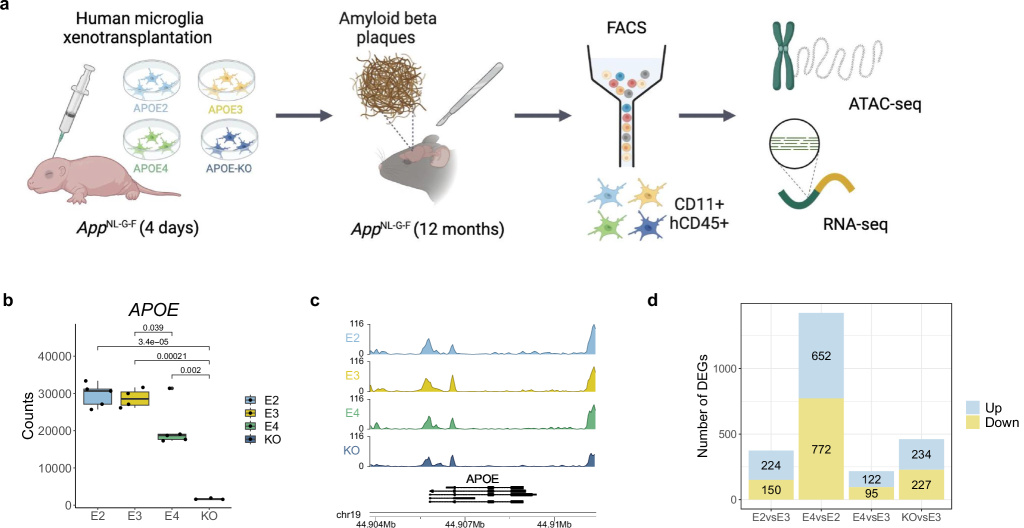
1. The APOE isoforms differentially shape the transcriptomic and epigenomic landscapes of human microglia xenografted into a mouse model of Alzheimer’s disease – published in Nature Communications: https://doi.org/10.1038/s41467-025-60099-4
2. CHAS infers cell type-specific signatures in bulk brain histone acetylation studies of neurological and psychiatric disorders – published in Cell Reports Methods: https://doi.org/10.1016/j.crmeth.2025.101032
Congratulations to Paulina Urbanaviciute, Leyla Abbasova and the whole team for a new publication in Nature Communications – CUT&Tag recovers up to half of ENCODE ChIP-seq histone acetylation peaks: https://doi.org/10.1038/s41467-025-58137-2
Congratulations to Dr Maria Tsalenchuk for her new publication in npj Parkinson’s Disease – Unique nigral and cortical pathways implicated by epigenomic and transcriptional analyses in rotenone Parkinson’s model: https://doi.org/10.1038/s41531-025-01049-1
The Marzi lab welcomes Magdy Mekdad, who is starting a PhD funded by the Wellcome DTP Advanced Therapies for Regenerative Medicine programme. The lab also welcomes Dr Samantha Lee and Eduard Jelinek who joined the group as postdoc and research assistant, respectively.
Dr Sarah Marzi spoke on the Dementia Researcher podcast episode “Failing Forward: What My Grant Rejection Taught Me: https://www.dementiaresearcher.nihr.ac.uk/podcast-failing-forward-what-my-grant-rejection-taught-me/
The UK DRI centre at King’s College London launched a new podcast series “Between The Signals” with Dr Sarah Mizielinska and Dr Sarah Marzi: https://www.ukdri.ac.uk/news-and-events/podcast-BTS-ep1-what-is-mnd